
MarsX - Chapter 4
A Remembered Earth Novel

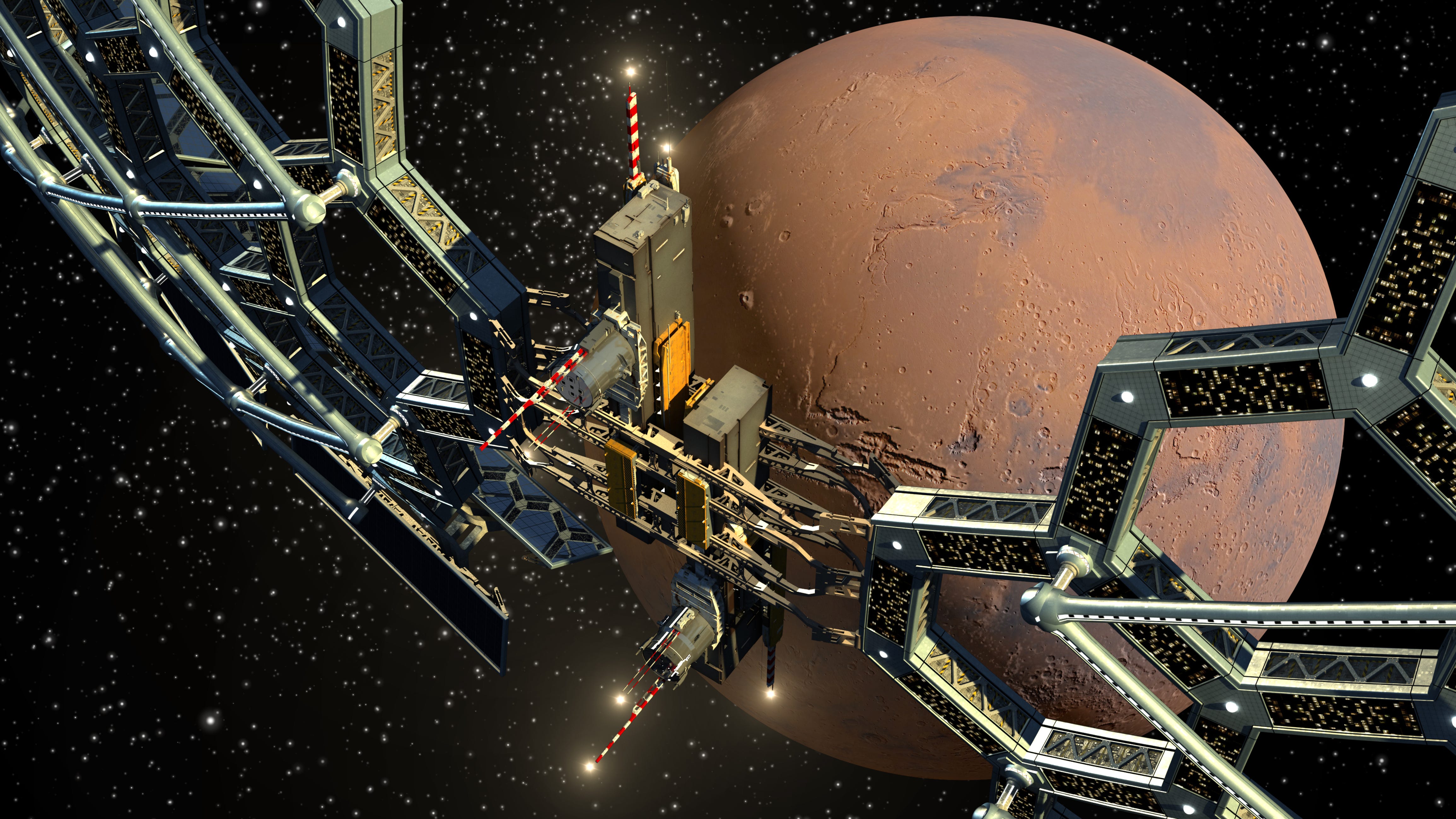
Image: ID 218650378 | Mars © 3000ad | Dreamstime.com
Laura started her senior year at Texas Tech while Robert started his sophomore year. Harold was nearby in Laken finishing his courses.
At the time Laura was studying for her final exams, she was also following the news from Columbiad, and it wasn’t good. Their latest test flight had failed, had exploded as the second stage ignited. Laura was disturbed but not surprised. There were also rumors that the company had overextended itself by buying the MarsX facility and now was running short of money.
Then, after her last exam she heard the news, Columbiad was suspending operations and was planning a reorganization. Laura wasn’t sure what that meant but she knew she wouldn’t be getting a job or even an internship at the company during the summer. She talked to her mom, and they decided she should go ahead and begin graduate school as soon as possible. Having already applied it was just a matter of accepting an offer and she did, to Texas Tech.
Shortly after she started to graduate school Columbiad announced bankruptcy. The old MarsX facilities were empty again and up for sale, though no buyers immediately stepped forward.
*****
Harold had finished his machinist degree, and since working for Columbiad was no longer an opportunity, decided to work for himself. With the help of his dad, he set up a small machine shop in Laken and after a year of hard work landed a job with an aerospace firm to supply several small parts for their new commercial airplane. Harold took out a very large loan and from there events moved fast, as he obtained a larger building, nearly forty thousand square feet, and hired more machinists, and outfitted his shop with the latest machinery. He had just turned twenty-two.
*****
Robert was finished with his bachelor’s degree in aerospace and was preparing to pursue a master’s degree. At a departmental cookout for incoming graduate students Robert met Laura. They talked for a moment and found out that each had been big fans of the old MarsX and both had worked briefly for Columbiad. Reminiscing about what might have been caused Laura to bring up meeting Harold all those years ago at a MarsX launch.
“Harold? Harold Graham?” asked Robert.
“Yeah,” she said, “that’s right I think.”
“Well, would you believe that I spent a recent summer working with Harold at the Columbiad location in west Texas,” he said.
“Really,” she said, “what a coincidence.”
“Yeah, last I heard, Harold was over in Laken running his own machine shop and doing pretty well,” he said.
“I wonder if he’s still interested in going to Mars?” she asked.
“I think we all are still interested,” said Robert, “we’re just not sure anymore, how we’ll get there.”
“That’s true,” she said.
“Well, I’m hungry,” he said. “You want to get some food?”
“Yeah,” she said.
Texas Tech encouraged all its students to get some work experience between semesters or part-time during semesters, but Robert hadn’t been motivated to do so since the demise of Columbiad. Now meeting someone like Laura who had many of his own interests and talking about their passion, living on Mars, he became motivated. Since there weren’t any aerospace jobs available in Harley that summer, Laura suggested he should apply to work in one of the groups at the university. He did and was accepted.
The group he joined was doing feasibility studies for Martian colonies. The group had access to the latest AI agent (Robert noticed they didn’t call it an assistant anymore) and he could use it to help with his project. This led to him being trained in its use by the group advisor.
“As you can see Robert, it’s very important to clarify your prompt to the agent, otherwise, it will spend a lot of time zeroing in on what you want and that will cost the department more money than necessary,” said the advisor.
“I understand,” said Robert. “This is more powerful than the assistant I used just a few months ago and I thought that was cutting-edge.”
“A few months is a long time in AI,” said the advisor. “What the AI companies have started doing is to use AI to help design AI. I expect by this time next year we’ll see even more changes than we saw in the past year.”
While he had thought about Mars for years this was the first time he had a knowledge of the engineering, science, and economics that could make a colony viable. He started with economic viability.
For some time, he had thought, a Mars colony would be dependent on Earth for many high-tech necessities. What could it trade in exchange? Anything of substantial weight, such as minerals and ores, would cost too much to ship back to Earth. The only thing that a Mars colony really had to offer Earthlings was Mars. Tourism seemed to be the only practical “goods” that might generate an income for the new colony.
So, the colony should have a view of an interesting area on Mars, maybe situated on the rim of a canyon like Valles Marineras, the largest in the Solar System. It should also be near interesting research areas he decided, because scientific tourism would be a strong component of the overall tourist trade. Robert was able to get the AI agent to propose several places that would meet his requirements, Robert chose the Candor region.
For itself, the colony would want to produce all its own food, air, and building materials. Robots, along with the new AI agents, such as he was using, would be essential for farming, manufacturing, and mining, because unlike humans that need expensive food, lodging, and entertainment, robots needed only energy and maintenance. The robots would be the largest category of imports from Earth, many coming with the settlers on the same ships.
Thus, materials would be produced by self-operating smelters, mining machines, and transported to the colony by self-driving loaders/unloaders and trucks. Manufacturing would be handled by self-operating 3-D printers, lasers, and mills. Assembly would be by robots, with repairs by humanoid robots and sometimes humans if needed.
Robots would also need to tend the farms including planting and harvesting. And humans? They would be engaged as hosts to the tourists and perform original research with the help of AI agents.
It wasn’t long before Robert had far outpaced the others in his group. The advisor proposed that he continue and write his own report which would be included in the group report at the end of summer.
Robert’s paper was submitted by his group advisor to a student contest held by one of the groups pushing for Mars settlement, Mars @ Home, and he won one of the top prizes. It brought him recognition from the community of activists, engineers, and scientists advocating for Mars.
Six months later Laura was finishing the first year of her doctorate program and working in the physics department. She was using the department’s AI budget to simulate a magnetosphere, which would eventually be used to protect the occupants of a spaceship in deep space, when a fellow student rushed in to ask if she had heard the news.
“What news?” asked Laura, somewhat irritated at being interrupted.
“The Chinese are on their way to Mars,” said the student and rushed out.
Laura’s first impulse was to shrug but then she started thinking.
Will the government react to this news by bankrolling aerospace companies to get us to Mars?
The government had certainly reacted just that way years before when it looked like the Chinese might settle the Moon first.
The government was always reactive, never proactive.
She went back to work on her project wondering when she might hear a response from the government. It wasn’t long.
That night Harold had worked late, the new AI agent he had bought to control the 3D printers was both intelligent and dumb, fast and slow. It reminded him of a scatterbrained individual that used to work at the company. As long as you carefully defined its task, it was excellent but leave one detail for the agent to decide and the entire job might be ruined.
Harold got back to his apartment just in time to hear an address from the president. First, the president reiterated what was known about the Chinese mission to Mars and offered that country congratulations. He then went on to stress the importance of Mars to the United States and that this country also had a program for a Mars landing.
When the president was finished Harold sat down with something to eat. He wasn’t sure if the president was bluffing about Mars or not. He certainly hadn’t heard of any program to place Americans on Mars, at least, nothing definite. Mostly, vague assurances that Mars was an aspirational goal. He thought about Robert. He had seen a little news blurb about him winning some prize for his work on a Martian colony. Harold would have to contact him and see if he knew anything. The whole incident brought back memories of his youthful excitement about the red planet.
A week later Harold was talking to Robert over the phone.
“How’s business?” asked Robert.
“Going well, Bob, we’re expanding again,” said Harold.
“How many employees does that make?” asked Robert.
“Over a hundred,” said Harold. “But I’m also thinking about the AI agents we’re using now. I think once we get used to managing them, they’ll increase our productivity by fifty times.”
“Really,” said Robert. “That’s amazing.”
“Yeah, and in expectation I’ve actually had to create some managerial positions and fill them internally. I always like to promote internally if possible.”
“That’s great,” said Robert.
“I saw that you won some kind of award for a paper you wrote on Mars,” said Harold.
“Yeah, it wasn’t much, but it was nice that my advisor at the time thought it was worth submitting,” said Robert.
“Well, a win’s a win,” said Harold. “Hey Bob, there’s something I wanted to ask you.”
“What’s that?” asked Robert.
“You heard anything about the government and this program they have about Mars?”
“All I know is what my professors say,” said Robert. “And that is, that there wasn’t a program until the president said there was one. But they are expecting to be contacted by the government about it.”
“You know we have an aerospace division at the company now,” said Harold. “About a third of our business is for the aerospace industry. I sure would like to do anything I can for a Mars program.”
“Yeah, me too,” said Robert. “It brings back old memories.”
“Sure does,” said Harold.
They talked a bit longer, finally promising to tell each other anything they heard about a Mars program.
Laura was the first to be affected by the government’s renewed interest in a Mars program when before she began to write her doctoral thesis her advisor asked her if she would like to work with a new aerospace company that had just won some government grants. They were reopening the Columbiad site and looking for scientists and engineers. She assured him she was interested, and he put her name in. That night she sent a message to Robert telling him. He was soon applying for a position at the company.
Harold got a short, cryptic message from Robert the next day saying, “They’re putting the band back together.” He then called Robert to get all the news.
*****
This is the last installment of this story without a paywall.
If you are interested in reading the novel immediately it is available (99 cents until July 31) at:
Future Chron Publishing (Author store and website, note 30% off order with code 777IWT930R)
Also, it will continue on Patreon for a few more chapters before it slips behind the paywall there.
Next, will probably be a few chapters of The Einstein Nexus which you can prepare for by reading a bit about it here and here.
Thank you for reading.